


 Cart
Cart
 sales@molnova.com



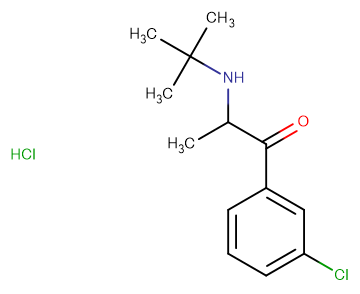
Bupropion hydrochloride
CAS No. 31677-93-7
Bupropion hydrochloride( NSC 315851 )
Catalog No. M14033 CAS No. 31677-93-7
Bupropion Hydrochloride is a unicyclic, aminoketone antidepressant.
Purity : >98% (HPLC)
 COA
Datasheet
HNMR
HPLC
MSDS
Handing Instructions
COA
Datasheet
HNMR
HPLC
MSDS
Handing Instructions
| Size | Price / USD | Stock | Quantity |
| 25MG | 57 | In Stock |


|
| 50MG | 75 | In Stock |
|
| 100MG | Get Quote | In Stock |
|
| 200MG | Get Quote | In Stock |
|
| 500MG | Get Quote | In Stock |
|
| 1G | Get Quote | In Stock |
|
Biological Information
-
Product NameBupropion hydrochloride
-
NoteResearch use only, not for human use.
-
Brief DescriptionBupropion Hydrochloride is a unicyclic, aminoketone antidepressant.
-
DescriptionBupropion Hydrochloride is a unicyclic, aminoketone antidepressant.
-
In VitroBupropion (Amfebutamone) hydrochloride inhibits CYP2D6 with the IC50 of 58 μM.Bupropion hydrochloride, an atypical antidepressant, induces endoplasmic reticulum stress and caspase-dependent cytotoxicity in SH-SY5Y cells.Bupropion hydrochloride activates caspase 3 through the induction of endoplasmic reticulum stress responses and activation of JNK, and consequently induces apoptotic cell death in SH-SY5Y cells.Bupropion (1-100 μg/mL) hydrochloride reduces cell viability. Bupropion-induced reduction in cell viability may have been a consequence of apoptotic mechanisms.Bupropion (100 μg/mL) hydrochloride increases the phosphorylated forms of EIF-2α, JNK, and p38 MAPK, and the expression of GRP78 within 1 h. Cell Viability Assay Cell Line:SH-SY5Y human catecholaminergic cells.Concentration:0, 1, 10, 50, and 100 μg/mL.Incubation Time:24 hours Result:Cell viability decreased significantly in a concentration-dependent manner. Western Blot Analysis Cell Line:SH-SY5Y human catecholaminergic cells Concentration:100 μg/mL.Incubation Time:1, 3, 8, 24 hours Result:The immunoreactivity for p-EIF-2α increased significantly within 1 h of Bupropion treatment and was sustained for 3 h, indicating that Bupropion rapidly stimulates PERK. Slightly but significantly increased the expression of GRP78 and markedly activated JNK. This early activation of the ER stress pathways by Bupropion returned to basal levels 8 h after treatment.
-
In VivoBupropion (Amfebutamone) hydrochloride shows convulsant and anticonvulsant effects in mice. Bupropion dose-dependently causes clonic convulsions in mice, with the CD50 (convulsive dose50, i.e., the dose producing convulsions in 50% of mice) at 119.7 mg/kg. Bupropion (10, 15, 20 and 40 mg/kg., i.p.; Male albino mice weighing between 22–30 g) hydrochloride dose-dependently decreases immobility period (in seconds) with respect to vehicle control group. ED50 values of bupropion in reducing the immobility period was found to be 18.5 and 18 mg/kg i.p., in forced swim test and tail suspension test, respectively. Bupropion (10, 20 and 40 mg/kg., i.p.) hydrochloride dose-dependently increases the concentration of free dopamine and its metabolite homovanillic acid in the mouse brain. Animal Model:Male Swiss mice weighing 20-25 g Dosage:100-160 mg/kg Administration:IP Result:Caused clonic convulsions, with the CD50 and CD97 being 119.7 (104.1-137.6) and 156.7 mg/kg, respectively. When given at a full convulsant dose of 160 mg/kg, the median latency was 6.00 min (3.50-8.15). Tonic convulsions were observed occasionally (1 per 8 mice) only in the groups receiving 140 or 160 mg/kg.
-
SynonymsNSC 315851
-
PathwayEndocrinology/Hormones
-
TargetAChR
-
RecptornAChR| DA transporter| Noradrenaline transporter (Sodium-dependent)
-
Research AreaNeurological Disease
-
Indication——
Chemical Information
-
CAS Number31677-93-7
-
Formula Weight276.21
-
Molecular FormulaC13H19Cl2NO
-
Purity>98% (HPLC)
-
SolubilityDMSO: 8 mg/mL (28.96 mM)
-
SMILESCl.CC(NC(C)(C)C)C(=O)C1=CC(Cl)=CC=C1
-
Chemical Name——
Shipping & Storage Information
-
Storage(-20℃)
-
ShippingWith Ice Pack
-
Stability≥ 2 years
Reference
1.Mitchell HA, et al. Biol Psychiatry. 2006 Nov 15;60(10):1046-52.
molnova catalog



related products
-
Moxalactam Disodium
Moxalactam sodium salt is an antibiotic compound more effective against Escherichia coli and Pseudomonas aeruginosathan cephalosporins.
-
Delphene
DEET is the most common active ingredient in insect repellents.
-
Galanthamine HBr
Galanthamine hydrobromide is a long-acting, centrally active acetylcholinesterase(AChE) inhibitor (IC50 = 410 nM) and allosteric potentiator at neuronal nicotinic ACh receptors.
